Standing waves you can see
Cymatics is what happens when you drive a fluid or a fine powder with a precise, sustained tone instead of noise. At most frequencies the surface just churns. But at specific resonant frequencies — determined by the size, shape, and depth of whatever's vibrating — the surface locks into a standing wave pattern: symmetric nodes where the surface stays still, and antinodes where it moves the most.
The number of rings, spokes, or lattice cells you see is a direct visual signature of that frequency's specific resonant mode. Change the frequency even slightly and the whole pattern reorganizes into a different mode — that's why the shots on this page are each labeled with the exact Hz they were shot at.
Built from a dead coffee table
The rig driving these patterns is a subwoofer speaker mounted into a repurposed coffee table, with a ring-light arc built overhead for consistent, shadowless top-down lighting — and a camera mounted dead-center in that arc, shooting straight down into the plate.
The subwoofer is driven directly by an oscillator tone from Cymatics Lab — the same dual-oscillator tool built into this site — rather than a pre-recorded track, so the frequency can be tuned live while watching the plate for the exact Hz where a pattern locks in.
Not just water
Plain water shows patterns, but they're faint and wash out fast. The mix used here is a non-Newtonian fluid — cornstarch suspended in water — which holds a pattern's fine structure far longer and resists collapsing back to flat between frames.
| Ingredient | Role |
|---|---|
| Cornstarch | Non-Newtonian base — holds fine pattern detail under vibration |
| Dish soap | Controls surface tension so the pattern reads cleanly at the surface |
| Food coloring | Contrast against the black plate for photography |
| A splash of vodka | Wetting agent — knocks down foam/bubbles that soap + water alone throw off |
- Mix cornstarch into water until it reaches a thick, pourable consistency.
- Add a few drops of dish soap and food coloring, stir gently to avoid foaming.
- Add a splash of vodka to knock down any remaining surface bubbles.
- Pour a thin, even layer onto the plate.
- Drive the plate with a tone from Cymatics Lab and sweep slowly until a pattern locks in.
Shots from the rig
All three of these came off the same rig, shot straight down through the ring-light arc.
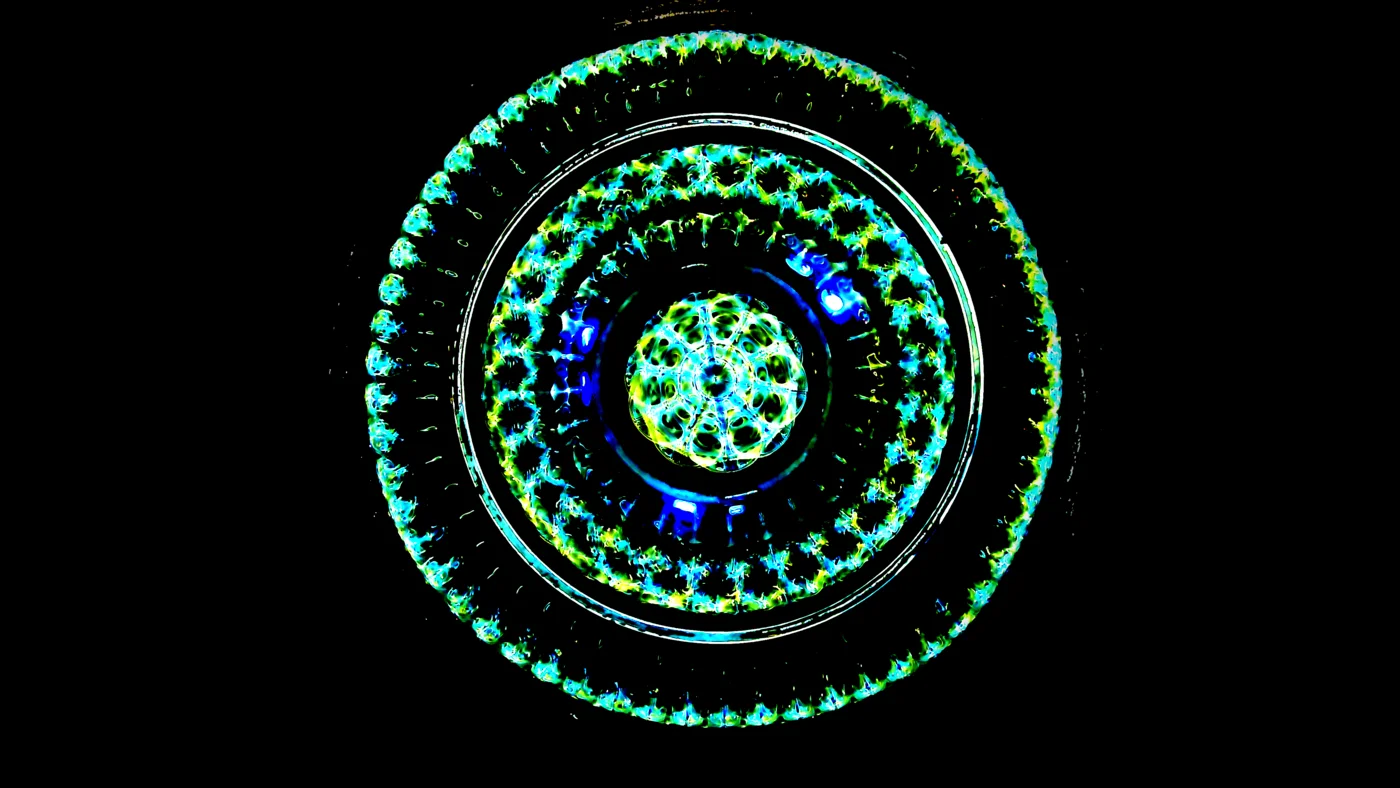
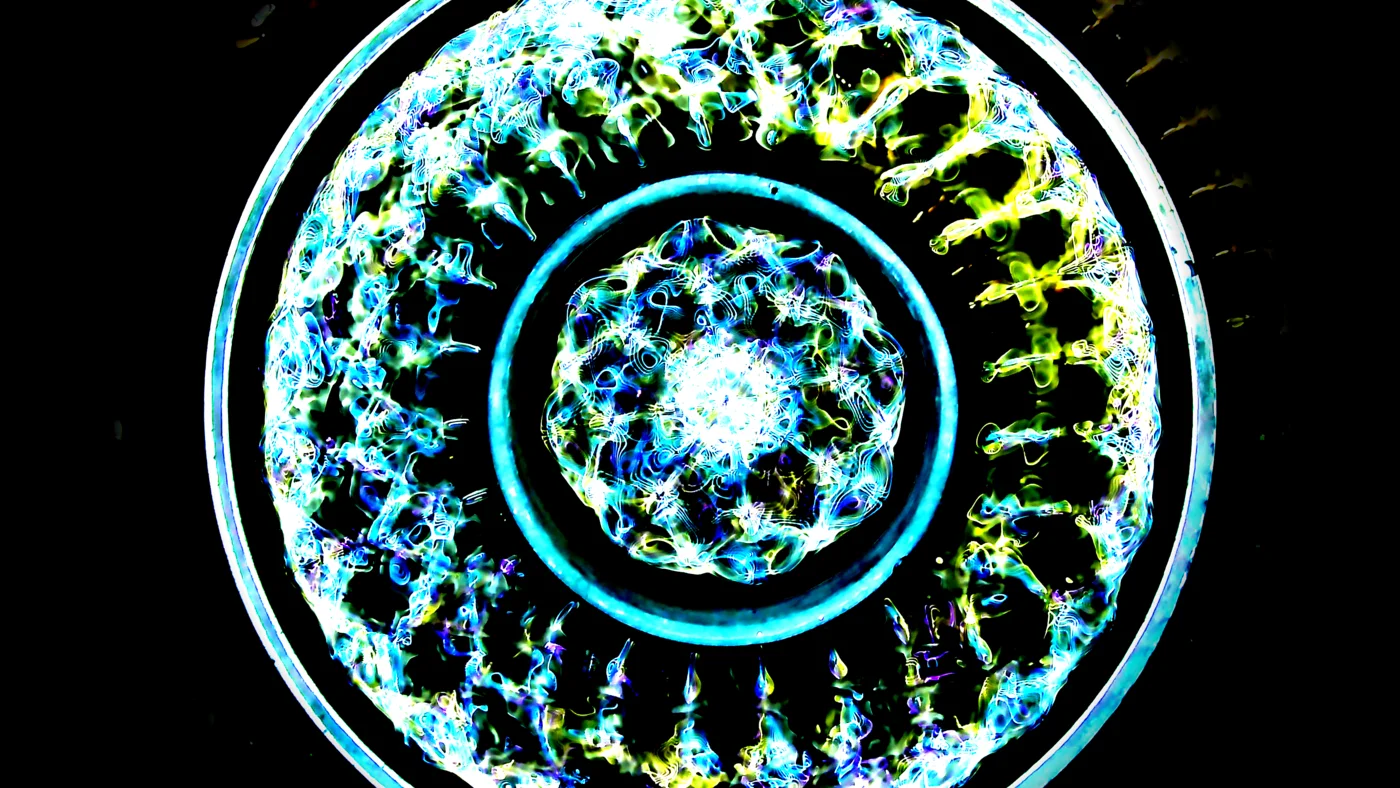
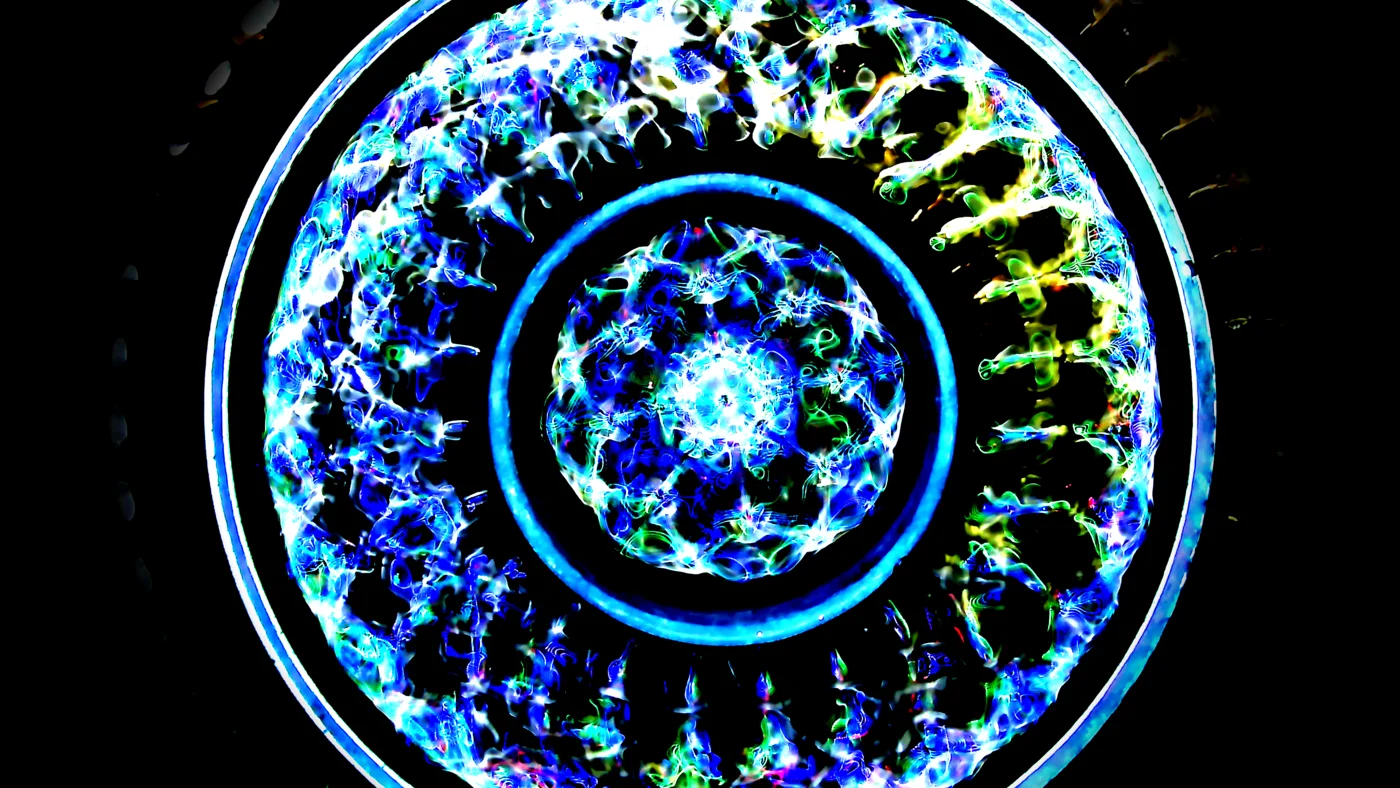
Prints of select shots — digital download or canvas — are available in the Fluid Art Gallery.
Make your own
Every pattern on this page started as a single sustained tone from Cymatics Lab — the same precision dual-oscillator tool built into this site, tunable to 0.01 Hz. No rig required to experiment with the tool itself; you'll need your own plate and driver to see it as pattern.